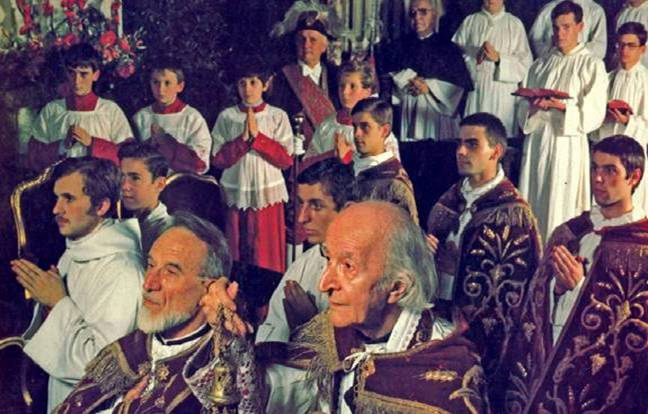
RECAPTURED PARIS CHURCH PRESERVES TRUE MASS
By Theresa Marie Moreau
A
single tap of a priest’s knuckle upon the blackened mahogany arm of a
choir chair signals the morning’s recitation of the Divine Office.
The
Roman-collared men gathered in the sanctuary of St. Nicolas du
Chardonnet de Paris raise the breviaries they hold in their hands and
flip the thin pages until each finds the day’s prayers.
“Deus, in
adjutórium meum inténde (O God, come to my assistance),” the church’s
pastor, seated on the Gospel side of the altar, chants in a rich voice.
From the Epistle side, four priests respond, “Dómine, ad adjuvándum me festína (O Lord, make haste to help me).”
Their
prayers rise. In the nave, a baker’s dozen of parishioners—some
kneeling, others sitting—assist with their own prayers, in silence.
For
the next fifteen minutes, the men, dressed in the ankle-length,
death-black cassocks appeal to God. They stand. They bow. They nod. They
cross themselves in pious affirmations, as the first rays from the
morning’s sun seep through the stained-glass depiction of the
Crucifixion, two stories overheard.
Although Catholic churches held rites like these for centuries, St. Nicolas du Chardonnet is no ordinary church.
Freed
from the diocesan bishop’s strangulating jurisdiction of the
post-Second Vatican Council’s “new-and-improved” Roman Catholic Church,
St. Nicolas, located at 23 rue des Bernardins in Paris, is one of a few
churches in secular France that regularly and exclusively offers the
traditional Latin-rite Mass.
It all began in 1977.
In
Paris at that time, there was one old priest who clung to the Tridentine
Mass of Pope St. Pius V, codified on July 14, 1570 following the
Council of Trent (1545-63). The old religious Frenchman refused to go
along with the progressives, the priests who experimented with
innovations tossed into the Novus Ordo Missae (the New Order of the
Mass).
That man was the Rev. François Ducaud-Bourget, ordained in
1934. A bit on the short side, he stood slightly hunched over, with a
hook nose that protruded from the center of his small face flanked by
long tufts of white hair covering his ears.
At times he pointed
his crooked finger through the air to emphasize certain points in his
sermons, always delivered with traditional instruction on morals and
doctrine. He never went the way of the post-Vatican II folksy style of
the self-reflective, feel-good homily commonly punctuated with jokes to
keep the parishioners happy—and awake. He wouldn’t degrade himself, or
his office, in that way.
Even though Pope Paul VI had signed the
Apostolic Constitution Missale Romanum on April 3, 1969, thereby handing
the Church a reformed Missal, Ducaud-Bourget disdained the man-centered
modernizations. He kept his back to parishioners. He continued to face
the altar and to pray the ancient rite. As those before him, he began in
the beginning with Psalm 42, a preparation for the sacrifice of the
Mass, and ended with the emotionally inspiring Last Gospel.
“He
never said the New Mass. Never,” says Monsieur l’abbé (the Rev.) Bernard
Lorber, of the Fraternité Sacerdotale Saint-Pie X (the Society of St.
Pius X) and the premier vicaire of St. Nicolas.
Best described as
a priest independent from the diocese, in the ’70s Ducaud-Bourget
frequently rented a meeting place where he could offer the Latin Mass
for the community. Sometimes he paid for a room in the La Salle Wagram, a
banquet hall near the Arc de Triomphe, at other times a room in Maubert
Mutalité Lecture Hall, a building very near St. Nicolas du Chardonnet.
But on February 27, 1977, Ducaud-Bourget had a plan.
When
traditionalists met at Maubert that Sunday, the old priest led everyone
across the street to St. Nicolas, which suffered greatly from the
chronic Novus Ordo syndrome: spiritual neglect. From 1968 to 1977,
diocesan priests from the parish church, St. Severin, located a few
blocks away, only opened the doors of St. Nicolas for a single new Mass
once a week. Usually, only a handful of parishioners bothered to show
up.
Ducaud-Bourget hoped to inject some supernatural powers of
Jesus, Mary and Joseph back into the church, thereby inoculating it
against the fatalistic forces of humanistic relativism. He had no idea
how successful he would be.
“It was his intention to say the Mass
here on this Sunday, then to pray during the day and then to leave the
place after,” Lorber says. “But there were so many people, they thought
they would stay one more day, then one more day, then one more day, then
one more day. Eventually, they decided to stay here, to remain here
forever.”
There was only one problem: The occupation was illegal.
Even
though the diocesan bishop of Paris was deemed the caretaker for the
property at the time, it was (and still is) the state of France that
owns every church built in that nation before 1905.
Going back a
few years, in 1905, the Law of Separation of the Churches and the State
(Loi de Séparation des Eglises et de L’Etat) made it official that the
state of France no longer recognized the Roman Catholic Church, but only
distinct associations cultuelles (associations for worship), ordered
established in each parish. Where no associations formed, the state
declared it would take possession of the church property.
From
his seat in the Vatican, Pope Pius X looked toward France and feared
spiritual demoralization: state intervention in religious parish life.
To take a firm stance against the meddling modernists, the Vicar of
Christ, in his 1906 encyclical “Gravissimo oficii,” forbade the
formation of any associations cultuelles.
Thus, Rome forfeited property for principle.
“The
Church lost everything,” says the Rev. Thierry Gaudray, 38-year-old
professor of Dogmatic Theology at St. Thomas Aquinas Seminary, in
Winona, Minnesota.
“Police entered the churches with guns. They
opened the tabernacles. They forced out of the churches and onto the
street the priests and nuns,” Gaudray describes.
Everything the
Church had gained with the Concordat of 1801, it lost in 1905. Not only
had the nineteenth-century agreement between Napoleon Bonaparte and Pope
Pius VII officially raised the recognition of Catholicism as the
religion of the majority of French citizens, but it also stipulated that
the state would financially support the clergy, which it did.
Although
one hundred years ago the Church lost its spot in France’s secular
pecking order, it wasn’t a total loser, exactly. For when the state took
custody of church property, at least it allowed bishops to remain in
charge of the churches. With one single stipulation: In every church,
one Mass was to be said each year. If not, the state would retake
control of the sacred structure and do with it what it wanted.
“So,
St. Nicolas was part of the diocese of Paris, and the bishop of Paris
was in charge of the building, but the state did own it,” Gaudray
clarifies. “Ducaud-Bourget took the church against the will of the
bishop, which was illegal. Taking over a church, to enter a church and
to take over, it is illegal.”
The state did decide to take legal
action, but only after Ducaud-Bourget and his army of Church Militants
had entrenched themselves deep in their sacred battlefield. For even on
the first night when Ducaud-Bourget and the others entered St. Nicolas,
they had adoration of the Blessed Sacrament. That lasted for the entire
first week.
What could officials do against a bunch of pacifist worshipers?
“The police could do nothing, because the people prayed,” Lorber says.
Months
following St. Nicolas’ liberation from the Conciliar Church, the state
indeed tried Ducaud-Bourget and issued a decree of expulsion. However,
officials never executed the judgment.
It’s now 2005,
twenty-eight years later, and traditionalists continue to occupy St.
Nicolas. Seated in the same sacristy where Ducaud-Borget sat, Lorber
looks toward the altar as he tries to explain the state’s inaction.
“Every
Sunday, Monseigneur had 5,000 people here in St. Nicolas, and if they
were forced to leave this church, they would just go to another church
and takeover that one. Officials understood it would be the same
problem, so they understood it was best to keep silent about our action.
So they decided to do nothing, to leave us here.”
And even if
the diocese wanted to take back St. Nicolas, on principle, it wouldn’t
work, Lorber says. The diocese wouldn’t be able to occupy all the
churches. They don’t have enough faithful who attend Mass.
Although
a reported eighty-five percent of the 60.4 million French claims to be
Roman Catholic, it is uncertain how many regularly go to church on
Sunday.
For a time, Ducaud-Bourget took care of the church, but
he was already old. Desperate to continue the traditional efforts he
resurrected in St. Nicolas, he sought help from one of the most
vociferous defenders of the Tridentine Mass: Archbishop Marcel Lefebvre,
who in 1969 founded the Society of St. Pius X, an order dedicated to
the training of priests in the rites of the ancient Church, pre-Second
Vatican Council style. Lefebvre aided Ducaud-Bourget and dispatched one
of the Society’s priests to help the elderly man.
Despite the
leadership he demonstrated in his part to keep the old Mass alive,
Lefebvre has had his detractors. Or maybe it was because of his
leadership.
Through the years, critics of the archbishop have
accused him of being a religious Pied Piper responsible for leading a
whole legion of Catholics into excommunication.
That
often-repeated description is absolutely not accurate, snaps Lorber, who
explains that Lefebvre was already settled into retirement in 1968 when
several young seminarians visited him. Unhappy with the Conciliar
Church, they approached him and begged him to teach them the traditions
of the faith, to pass on what he, himself, had learned.
“The seminarians went to him and asked him why had did not found a seminary. He did not want to,” Lorber says.
“I
am an old man,” Lefebvre told them and sent the young men to a seminary
in Fribourg, Switzerland. However, the modernistic teachings in that
religious school were no better than any other seminary. The following
year, the desperate seminarians and priests returned and insisted the
archbishop establish a seminary where novitiates could learn the
ancient-yet-solid foundations of the faith, including the Tridentine
Mass.
Lefebvre acquiesced.
Meanwhile, in Paris,
Ducaud-Bourget continued the occupation of St. Nicolas until his death
in 1984. Subsequently, his body was interred behind the main altar,
where he had offered the old Mass every day in the last years of his
life. After the old priest’s death, Lefebvre sent two more priests from
the Society to the Parisian church. Ducaud-Bourget’s dream would not die
with him.
Sticklers to tradition, like those in the Society,
made the hierarchy in Rome cringe. Since the adoption of the vernacular
rite in 1969, the Vatican found it had to deal with the holdovers who
preferred the Latin Mass and refused to offer or even attend the new
Mass, claiming it was a Protestantized fabrication.
Only a couple
years into his pontificate, Pope John Paul II established a
nine-cardinal commission at the Vatican to study the Mass problem. On
October 3, 1984, the Congregation for Divine Worship issued its circular
letter, “Quattor Abhinc Annos.”
This document describes the
granting of and the restrictions placed on what is now commonly referred
to as the Indult Mass. Indult, from the Latin indulgere (to indulge),
is a privilege granted by the pope to bishops and others to do an action
that the law of the Church otherwise prohibits.
Yet the term
“Indult” is misplaced, since the Latin Tridentine Mass has never been
prohibited, which Alfons Maria Cardinal Stickler—one of the nine
cardinals on the commission—admitted in May 1995 while speaking at a
ChristiFideles conference held in New Jersey.
Stipulations in the
1984 “Indult” included that the Mass only be offered (definitely not in
parish churches) to those who request it, and those parishioners could
in no way share the beliefs of those who question and doubt the validity
of the new Mass.
Meanwhile, the Society of St. Pius X continued
to flourish and continued to offer the old Mass, not only at St.
Nicolas, but also at other churches around the world.
Lorber, now
41 years old, has witnessed much of the Society’s growth, despite the
hardships the traditionalist order has had to endure at the manipulative
hands of the hierarchy.
Ordained on June 29, 1988, Lorber was
one of the last to have his hands consecrated by Lefebvre, who died in
1991. A few weeks before his ordination, Lorber served the low Mass for
the archbishop in the Notre Dame des Champs Chapel in the Seminary of
Ecône on May 8, a Sunday.
Lefebvre told Lorber how during the
month before, in April 1988, he went to Rome to discuss with the Vatican
the impending consecration of the bishops he had planned to take his
place for the administering of sacraments, the ordaining of priests and
the confirming of the faithful.
Born in 1905, the archbishop was old and did not want to leave his priests without a spiritual leader.
The
Vatican’s representative at that time was Joseph Ratzinger, then a
cardinal and now Pope Benedict XVI. In the end, after lengthy
discussions and many compromises, a protocol was signed on May 5, 1988.
The agreement stipulated that Rome would give Lefebvre one bishop and a
commission in Rome to discuss the traditional Mass.
“Ratzinger was quite hard with Archbishop Lefebvre,” Lorber says.
After
Lefebvre signed the protocol, he told Ratzinger that he had already
announced the episcopal consecrations for the following June 30.
Ratzinger’s response: No. It’s not possible.
August? asked Lefebvre.
No. It’s not possible, Ratzinger responded.
November?
No.
December?
No.
Lefebvre
left Rome and sought solace at the Seminary of Ecône, in Switzerland.
He prayed. On May 6, he wrote to the Vatican and expressed that he did
not have confidence in the agreement.
“During the discussions
with Rome, it was very painful,” Lefebvre told Lorber, “It was very
painful, because they don’t take care of their souls. The only one thing
they try to do is save their image, and this is why I will consecrate
the bishops without Rome.”
But the Vatican continued to pressure the archbishop.
“The
day before the consecrations, Rome sent a messenger, a nuncio from
Switzerland, to take Archbishop Lefebvre back with him. The Pope asked
if he could go to Rome to talk with him. The seminarians told him it was
a good joke,” Lorber says. “The intention was to make Lefebvre nervous
about the consecrations, but it didn’t disturb Archbishop Lefebvre.”
Nothing
bothered him. Not even the rumors circulating that he would be
“excommunicated” if he went ahead with his plans for June 30.
As for the excommunication of bishops, there were precedents.
Decades
earlier, in the 1950s, Pope Pius XII introduced into Canon Law, the
prohibition of bishops consecrating bishops without papal approval. The
Pope found this necessary after the Communist takeover in China. That
was when the faithful of the Roman Catholic Church (the Underground
Chinese Catholics) in China found themselves persecuted after the rise
of the Chinese Patriotic Church (the pseudo-religious association that
collaborated with the Chinese Communist government), explains Gaudray.
“The
law of the Church is for the good of the souls, so when Pius XII issued
the decree of excommunication for the bishops in China, it was for the
good of the Church. It was to prevent the setting up of the national
church in China, which is not Catholic. It was to make people aware that
the Pope does not agree at all and for them not to be part of the
schismatic church,” Gaudray says.
“The purpose of Archbishop
Lefebvre was not to form another Church. Our bishops do not have
authority, even in the Society. We have bishops for the sacraments,
ordinations and confirmations. In China it was to form a Church.”
The day finally arrived.
Lefebvre predicted in his sermon before the consecrations there would be an attempt to excommunicate him.
Nonetheless,
on June 30, without papal permission, Lefebvre consecrated four
bishops: Bernard Fellay, Bernard Tissier de Mallerais, Richard
Williamson and Alfonso de Galarreta.
“Many realized that the consecrations was an historic event for the Church,” Lorber says.
It was a matter of preservation, not of the self, but of the faith.
As
predicted, on July 1, 1988, the Vatican, represented by Bernardinus
Cardinal Gantin, prefect of the Congregation of Bishops, issued the
following: “I declare that the above-mentioned Monsignor Marcel
Lefebvre, and Bernard Fellay, Bernard Tissier de Mallerais, Richard
Williamson and Alfonso de Galarreta have incurred ipso facto
excommunication latae sententiae reserved to the Apostolic See.” This
was accompanied by even more threats.
“The priests and faithful
are warned not to support the schism of Monsignor Lefebvre, otherwise
they shall incur ipso facto the very grave penalty of excommunication.”
Excommunication,
explains Gaudray from his office in Winona, is a severe technical
punishment issued by the Pope that severs all ties between the chastised
and the Church. Penalized priests cannot give or receive the
sacraments. They cannot offer or even attend Mass (new or old).
“This, of course, means it is a punishment, but it implies a fault, that something is wrong,” Gaudray says.
Both Gaudray and Lorber claim the excommunication was unjustified. For, they believe, Lefebvre committed no wrongdoing.
“This
excommunication has no value, really,” Lorber says. “Because for there
to be punishment, one must have done something wrong. Archbishop
Lefebvre didn’t have any schismatic intention by consecrating the
bishops. His act was never a wrong, and he should never have been
punished. Furthermore, by excommunicating Archbishop Lefebvre, Rome lost
its credibility, because it lets bishops and theologians, like Hans
Küng, Leonardo Boff and all the liberal theologians run around and teach
heresies, and they were never excommunicated by John Paul II.”
Lefebvre only tried to keep the old Mass, and the true Catholic religion, alive.
“Without the actions of Archbishop Lefebvre, there would not be anymore priests who could say the Tridentine Mass,” Lorber says.
Thus,
the traditional priests of St. Nicolas continue the ancient rites of
the one, holy, catholic, apostolic Church they learned from the old
archbishop, coaxed out of retirement, reluctantly.
Still, every
morning, a single tap of a priest’s knuckle upon the blackened mahogany
arm of a choir chair signals the morning’s recitation of the Divine
Office.
The Roman-collared men gathered in the sanctuary of St.
Nicolas du Chardonnet de Paris raise the breviaries they hold in their
hands and flip the thin pages until each finds the day’s prayers.
“Deus, in adjutórium meum inténde,” chants one, followed by the others responding, “Dómine, ad adjuvándum me festína.”
----------------------------------------------------
First Published in Catholic Family News, December 2005