Tilanqiao: Christ Crucified in China
By Theresa Marie Moreau
“Ready
for yard time! Ready for yard time!” Telian Shao, the second-floor
worker prisoner announced as he walked through the corridor. Shao had
been sentenced to life in prison, because he had killed his wife after
he found out that she had a lover.
As the guard unlocked the cell
doors, the inmates lined up, two by two, and waited for the order to
walk to the basketball court between Cellblock Number 1 and Cellblock
Number 2.
Prior to his transfer to Tilanqaio, Chen had been
locked up in the Xuhui District Police Station, where one of his
cellmates, Old Yu, had told him about executions in the basketball
courts between the cellblocks.
Before he was arrested, Yu had
been an investigator for the police department and had once been the
supervisor of Officer Zhang, their jailer in the police station.
Yu
explained that when Zhang worked for the Public Security Bureau, he
zealously joined in the Campaign to Suppress Counterrevolutionaries
(1950-53). Day and night, he helped in the capture and interrogation of
countless suspected enemies of the State.
However, the number of
prisoners quickly surpassed the number of available cells. With not
enough room in the jails, prisoners were liquidated, sometimes in the
Tilanqiao basketball courts.
Like other executioners, Zhang
enjoyed killing prisoners for the thrill of it. He would raise his
pistol, only inches away from the back of the victim’s neck, and pull
the trigger, sending the bullet into the neck and out through the mouth.
However,
one time Zhang had either aimed a little too high or scratched the
bullet on a rock for more explosive destruction. As a result, the bullet
hit the back of the victim’s skull, and his brains and blood spattered
everywhere around the basketball court, including Zhang’s face and
clothing.
After that, Zhang began having nightmares, with visions
of his victims haunting him in his sleep. Even during his waking hours,
he feared that the dead would drag him into hell.
During exercise yard time, when Chen saw the basketball courts, he remembered what Yu had told him.
In the yard, inmates stayed in two-by-two line formation, walking circles around the court, nodding and smiling to one another.
“You see the first one?” whispered Chen’s cellmate Youzhen Hong, who was walking behind him.
Chen
looked toward the front of the line, where he saw a short man wearing a
government-issued policeman’s uniform, different from the usual
prisoner clothing. He wore a blue, thick cotton jacket with four pockets
in the front – two at the chest and two at the waist, thick cotton
pants and army-issued thick cotton shoes, commonly called the big-head
shoes. The white cloth badge he wore over his chest indicated that he
was Prisoner Number 28234.
He is wearing government clothes. He must not have any family visit him, Chen thought.
“That is Pinmei Gong,” Hong whispered.
Chen had heard about Shanghai’s Roman Catholic Bishop Pinmei “Ignatius” Gong (Pin-Mei Kung). He respected the man.
Gong
and several hundred other Shanghai Catholics had been arrested on
September 8, 1955, in a big round up of those who had refused to
renounce the authority of the Pope and join the Three-Self Reform
Movement. With its three principles – self-government, self-propagation
and self-support – it was the regime’s Communist, Marxist, atheist
version of the Roman Catholic Church. Unsuccessful at winning over
converts, the Movement had been replaced by and integrated into the
Chinese Catholic Patriotic Association, on July 15, 1957.
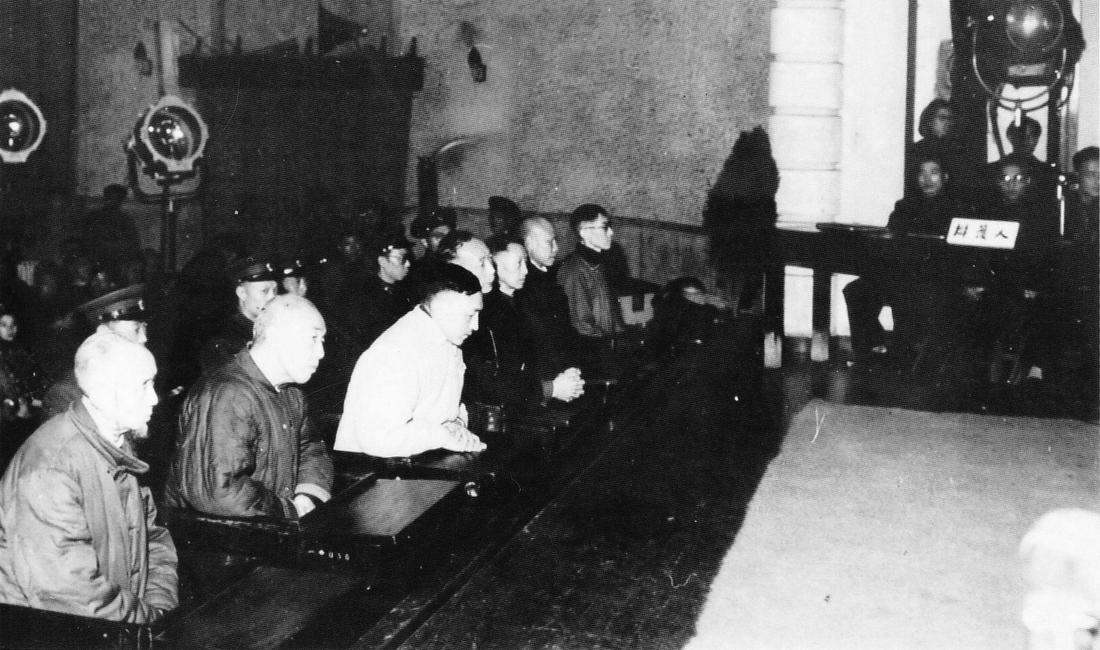
After
his arrest, in 1955, Gong wasn’t sentenced until nearly five years
later, on March 17, 1960, along with 12 other Catholic priests, after a
two-day “trial” in the Court of Criminal Justice, Shanghai City
Intermediate People’s Court, Zhong Xing, Number 162.
In part, the verdict and subsequent sentencing read as follows:
“Defendant:
Pinmei Gong, alias Tian-Chueh Kung, male, born in 1901, Chuan Sha
County, Shanghai City. Prior to his arrest, he was the Roman Catholic
bishop of the Shanghai diocese, and concurrently bishop of the diocese
of Suzhou. Former residence in this city’s Sichuan Road South, Number
36. Now under arrest…
“On the basis of the evidence for criminal
activities on the part of Pinmei Gong’s counterrevolutionary and
anti-government organization, our court is perfectly cognizant of the
fact that the accused, Pinmei Gong, is the leader of this
counterrevolutionary and anti-government organization, hiding under the
cloak of religion. He is collaborating with the imperialists in the
betrayal of his motherland, and has served as an important tool for the
imperialists to overthrow the People’s democratic political rights of
our country to such an extent that he has accomplished serious
violations of the country’s interests. In this case, each defendant has
infringed the People’s Republic’s law against counterrevolutionary
activities…all of which criminal activities are punishable by law. Our
court, in accordance with the concrete circumstances of the defendant’s
criminal activities, and with respect to any expression of repentance on
the part of the accused subsequent to their arrest, has decided to pass
the following judgment:
“The accused, Pinmei Gong, is the head
and leader of the counterrevolutionary and anti-government organization;
he is in league with the imperialists, betrayed his motherland, and his
crimes are of a very serious nature. But after his case had been
brought forward, when confronted with actual circumstantial evidence, he
did not deny his role, and furthermore he had something to reveal on
the subject of how the imperialists under the cover of religion plotted
subversive actions. Under the magnanimity of the law we hereby sentence
him to lifetime imprisonment, and hereby strip him for life of all his
political rights.”
During his incarceration, Gong had never been
allowed any visitors. His mother and other relatives made countless
attempts to see him, but authorities never permitted the bishop any
visitation rights. His family also made endless efforts to get care
packages to him, even through the Red Cross, but he never received a
single one.
Gong had lived in isolation in a cell on the first
floor of Cellblock Number 1, until the Cultural Revolution erupted, then
he was moved up to the second floor.
Chen stared at the bishop
of Shanghai, forced to wear a shabby, policeman’s uniform. Barely 5 feet
tall, the old man symbolized the strength of the Roman Catholic Church,
not only in China, but in the world. His courageous strength and
endless faith in God and Pope made him one of the most hated, most
feared men by the Communists.
Yes, Chen had a great respect for Bishop Gong.